Microneedling and retinol are two of the most popular ways to improve skin texture, reduce fine lines, and encourage healthier, younger-looking skin.
So it might seem counterintuitive to stop one treatment in order to do the other.
But while they can work extremely well together as part of a long-term skincare routine, timing matters. And as with most skincare, a little patience pays off.
So, how long after microneedling can you use retinol? And what should you use in the meantime?
As a general rule, wait around 5–7 days after your microneedling treatment before restarting retinol, and potentially longer after deeper treatments such as RF microneedling.
The exact timing always depends on multiple factors – including the type of microneedling treatment you’re having, the strength of your retinol, and how quickly your skin recovers. Ultimately, your provider’s aftercare instructions should always take priority.
Here’s everything you need to know about using retinol safely before and after microneedling, including what to use, what to avoid, and how to get the best possible results.
Why should you avoid retinol after microneedling?
To understand why retinol and microneedling need to be carefully timed, it helps to understand how each works.
Microneedling uses tiny, sterile needles to create thousands of controlled micro-injuries in the skin. This stimulates the body’s natural healing response, encouraging the production of new collagen and elastin to improve skin texture, firmness, and overall appearance.
It’s a minimally invasive procedure with relatively little downtime. However, the process does temporarily disrupt your skin’s protective barrier, leaving it more sensitive and vulnerable to irritation while it heals. That’s why following the right aftercare routine is so important.
Retinol, meanwhile, belongs to a family of vitamin A derivatives known as retinoids. These range from over-the-counter retinol and retinal (retinaldehyde) to medications like adapalene and prescription tretinoin. Broadly, they all work in a similar way, encouraging skin cell turnover and supporting collagen production, which is why they’re excellent for improving fine lines, uneven skin tone, and signs of aging. But they’re also powerful active ingredients that can cause irritation, particularly when your skin is already sensitive or recovering.
So while we’ll say “retinol” throughout this article, the same general timings and precautions apply to other topical retinoids. Stronger prescription formulas may need longer.
Essentially, retinoids and microneedling are both brilliant for your skin, but combining the two too soon can overwhelm skin that’s already working hard to repair itself.
What happens if you use retinol too soon after microneedling?
Applying retinol before your skin has sufficiently recovered can cause:
- Redness, burning, or stinging
- Excessive dryness, flaking, and peeling
- Inflammation and prolonged sensitivity
- Delayed healing and, in some cases, an increased risk of post-inflammatory hyperpigmentation
This doesn’t mean retinol is harmful or that you shouldn’t use it alongside microneedling. Quite the opposite, in fact, as both are valuable parts of an effective skin rejuvenation routine.
The key is simply giving your skin enough time to recover between them.
If you’ve accidentally applied retinol too soon after treatment, don’t panic. One application doesn’t automatically mean you’ve damaged your skin or compromised your results.
If the product is still on your skin and causing irritation, rinse it off gently (don’t scrub or rub your face), and return to a simple, soothing skincare routine as originally directed by your practitioner. Contact your clinic if irritation develops, persists, or worsens.
When can I use retinol after microneedling?
You should always be given clear personalized directions as part of your consultation, based on your individual circumstances: your skin type, treatment type, and other external factors.
However, as a general guideline, you’ll need to wait around 5–7 days after professional microneedling before using retinol again. For more intensive treatments, including some radiofrequency (RF) microneedling procedures, 7–14 days might be recommended.
When you’re ready to restart, follow these three simple steps:
1. Make sure your skin has fully recovered: Don’t rely on the calendar alone. Wait until any redness, tenderness, tightness, or peeling has resolved. Even if your skin looks and feels normal after a day or two, it may still need more time to recover.
2. Reintroduce retinol gradually: Start with just one or two applications during the first week, and slowly increase to your usual routine. If you normally use a high-strength retinol, consider starting with a gentler formulation.
3. Monitor your skin’s response: Use a gentle moisturizer to help prevent dryness, and pay attention to any signs of irritation. If you experience unusual redness, stinging, or peeling, stop using retinol and give your skin more time.
Should you stop retinol before microneedling?
Yes, preparing your skin before treatment is just as important as caring for it afterward.
There’s no single rule as to when you should stop retinol before microneedling, but pausing it at least 3–5 days before treatment is generally recommended, and often longer for prescription retinoids like tretinoin. Your provider can tell you exactly when to stop.
The same goes for other active ingredients, including AHAs and BHAs (such as glycolic or salicylic acid), benzoyl peroxide, and exfoliating scrubs, as well as excessive sun exposure.
Basically, the goal is simple: arrive with skin that’s as calm, strong, and healthy as possible.
Can you use vitamin C after microneedling?
Vitamin C is another great ingredient known for achieving healthy, glowing skin, so it’s easy to assume it’s a good one to use after microneedling.
However, vitamin C is also an active skincare ingredient, and some formulations – particularly those containing acidic L-ascorbic acid – can be too irritating for freshly treated skin.
As with retinol, it’s generally best to wait around 5–7 days, or until your skin has fully calmed, before reintroducing vitamin C after microneedling.
What can you use instead of retinol after microneedling?
A simple hyaluronic acid serum is one of the best products you can use after microneedling, as HA is gentle and super hydrating – exactly what your skin needs.
A gentle fragrance-free cleanser, hydrating moisturizer, and broad-spectrum sunscreen are the other key products to use. And remember to steer clear of AHAs and BHAs, benzoyl peroxide, vitamin C, physical scrubs, fragranced products, and alcohol-based toners, all of which can irritate healing skin.
In short – you don’t need a complicated skincare routine for a week or two after microneedling. In fact, keeping things simple is usually best.
Focus on skin hydration, supporting your skin barrier, and avoiding irritation. And let your body’s natural healing and regeneration processes do the rest.
Microneedling aftercare: your essential dos and don’ts
The best way to protect your skin and get the most from your microneedling results is to keep your skincare routine simple, follow your practitioner’s instructions, and give your skin time to recover.
Here’s a quick summary of what to do – and what to avoid – at each stage.
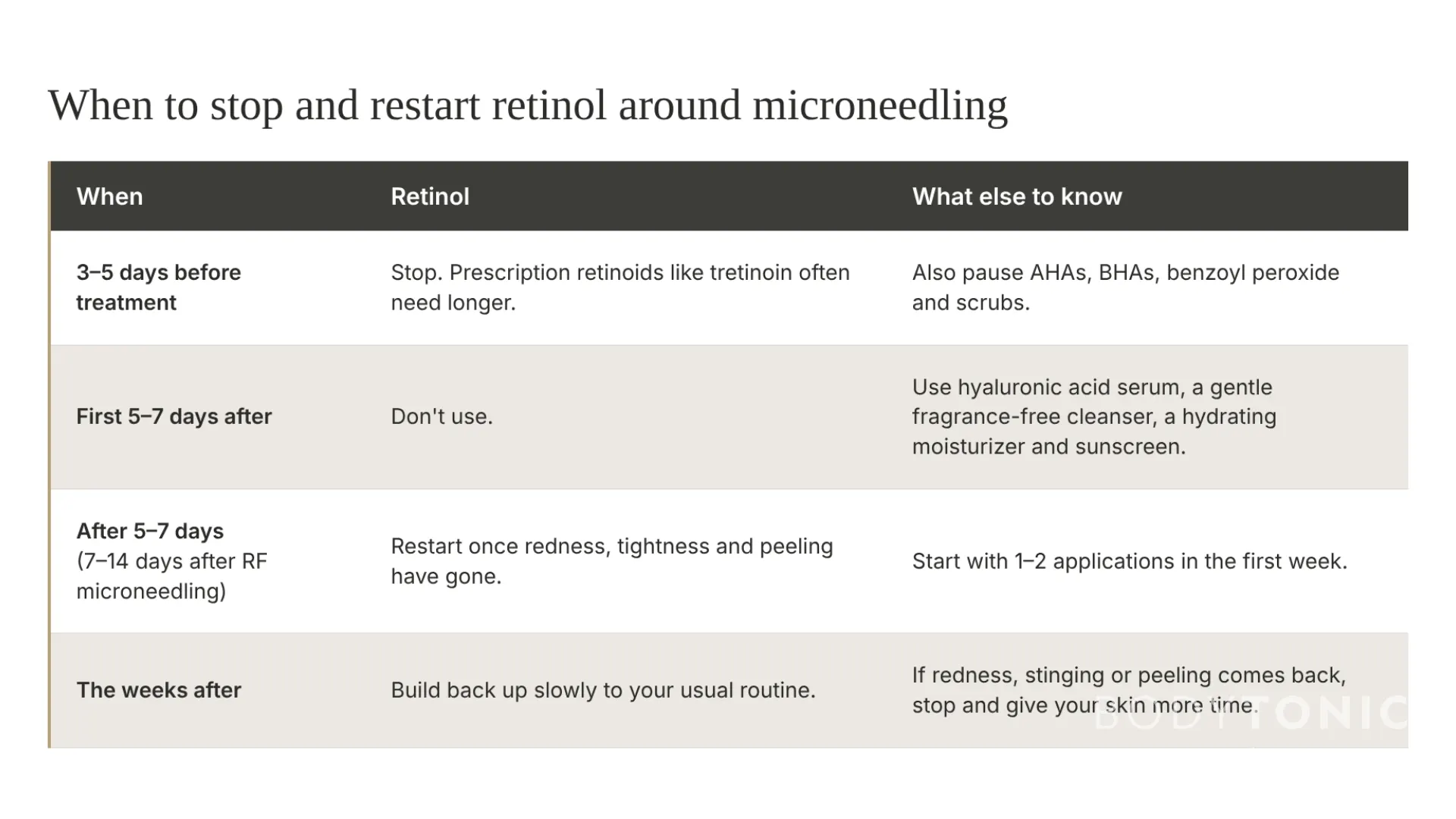
Remember: These are general guidelines for professional microneedling. More intensive treatments, including RF microneedling, may require a longer recovery period. Always follow your provider’s personalized advice.
Expert microneedling and skincare advice at BodyTonic
The secret to getting the most from microneedling (and retinol) is patience: give your skin time to heal, keep your routine simple, and reintroduce your actives gradually.
Every skin type is different, so if you’re ever unsure what to use or when, we’re happy to help.
At BodyTonic Cleveland, we offer SkinPen and VirtueRF microneedling alongside personalized skincare advice to suit your skin and your goals.
Get in touch with our expert team to book a consultation, and find out how we can help your skin to glow.