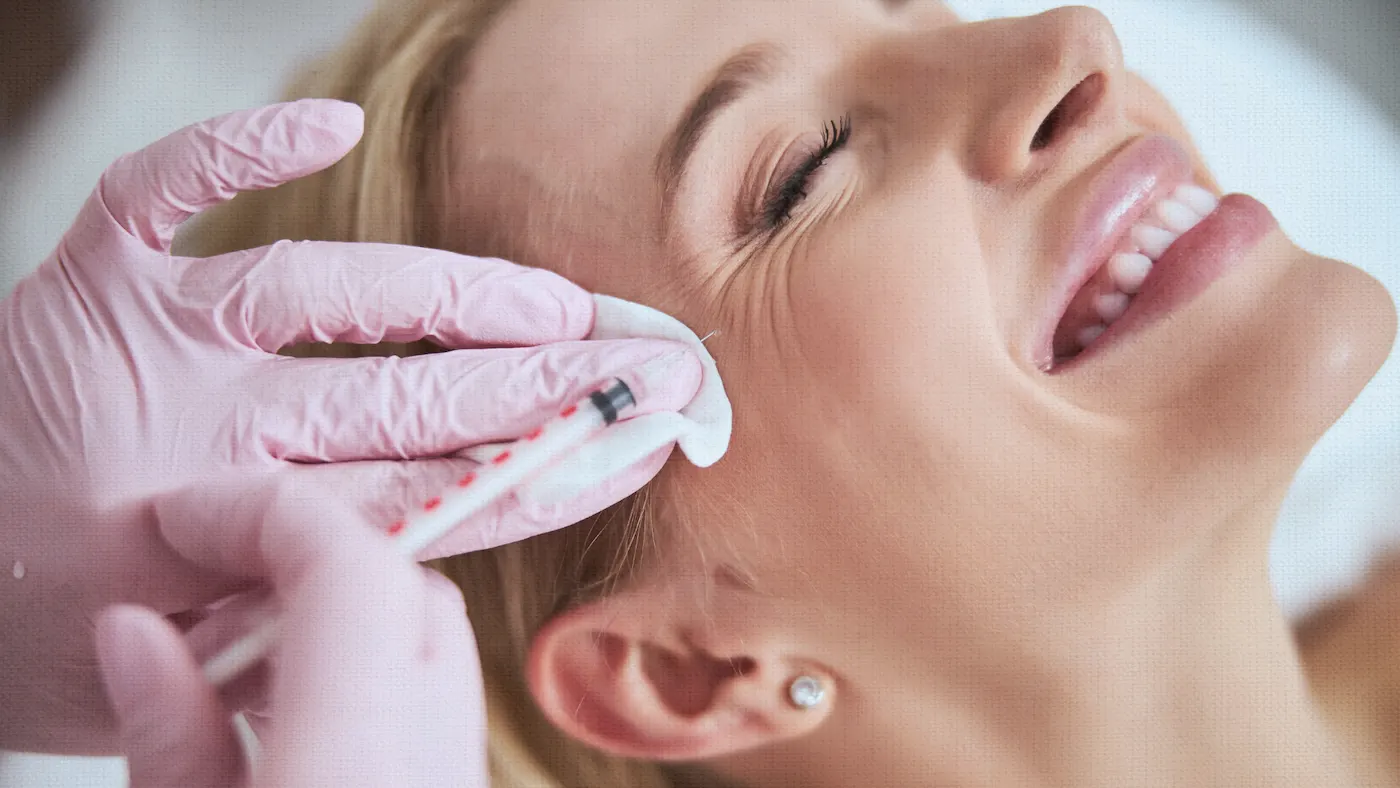
For most people, the best treatment for crow’s feet is a neurotoxin such as Botox, Xeomin or Dysport. It relaxes the muscle that creases the skin at the corners of your eyes when you smile or squint. If your lines still show when your face is relaxed, a laser such as CoolPeel or Moxi can help smooth them, usually after a neurotoxin. Below, we explain what causes crow’s feet, how to tell which type you have, how long Botox lasts and what it costs.
What are crow’s feet?
Crow’s feet, or lateral canthal lines, are the fine lines that fan out from the outer corners of your eyes. They come in two types. Dynamic lines appear only when you smile or squint. Static lines stay visible when your face is relaxed. Knowing which type you have decides which treatment works.
To check, look in a mirror with your face completely relaxed, then smile. If the lines only show when you smile, they’re dynamic. If you can still see them at rest, they’re static. Many people have a mix of both.
The best treatment for crow’s feet depends on several factors including line type, wrinkle depth and skin health. No matter whether you have static or dynamic lines, there are treatment options available to you that can help soften lines and prevent wrinkles.
During a consultation with us at BodyTonic, you can get more information about Botox, Xeomin and Dysport for crow’s feet. You can also explore additional options such as CoolPeel, Moxi, BBL and RF microneedling. The key is to pursue personalized treatment that will lead to tailored results.
What causes crow’s feet?
Crow’s feet form when two things happen together. The muscle around your eye contracts every time you smile, laugh or squint, folding the skin at the outer corners. At the same time, your skin slowly loses the collagen and elastin that help it spring back. Sun exposure speeds up that loss.
Each expression folds the skin in the same place. While your skin has plenty of collagen and elastin, it smooths out again, which is why getting crow’s feet when smiling is normal at any age. Over the years, the skin recovers a little less each time, until the crease stays when your face is at rest. That’s how a dynamic line becomes a static one.
How soon that happens varies. According to the Cleveland Clinic, you may first notice crow’s feet in your 30s, or not until your 40s. Genetics, sun exposure, sunscreen use and diet all play a part. Sunglasses help twice: they block UV and stop you squinting, which works the same muscle.
How to fix crow’s feet
The best treatment for crow’s feet depends on the type of lines you have, how deep they are and the result you want. For most people, the starting point is a neurotoxin such as Botox, Xeomin or Dysport. Laser comes in when lines stay visible at rest.
- Dynamic lines (only visible when you smile or squint): a neurotoxin such as Botox is usually the best treatment. It relaxes the muscle that creases the skin.
- Static lines (visible at rest): start with a neurotoxin, then consider a laser such as CoolPeel (a CO2 laser) or Moxi to smooth the etched lines.
- Filler: rarely used for crow’s feet, because it doesn’t stop the muscle movement that causes dynamic lines.
Can skincare get rid of crow’s feet?
When you couple your skincare routine with products that soften and plump your face, you can minimize the appearance of fine lines and wrinkles around the outer corners of your eyes. However, skincare products alone will not eliminate crow’s feet.
For skincare to have the most significant impact, you need to start early and prioritize your routine. Using moisturizer daily and wearing sunscreen whenever you are outside can help prevent dynamic lines from turning into static lines. Caring for your skin should remain a high priority.
Is Botox the best treatment for crow’s feet?
Botox is one of the best treatments for crow’s feet, and will likely be the first option you turn to. It relaxes the muscle that creases the skin around the outer corner of the eyes. It’s also been FDA-approved for crow’s feet since 2013, so you can feel confident in this tried-and-true method.
How many units of Botox for crow’s feet?
Typically, 24 units of Botox are needed to treat crow’s feet (12 units on each side of the face). This is in line with FDA recommendations, which note that 12 units of Botox should be injected into three distinct points on the outer corner of the eye on each side of the face.
Xeomin and Dysport for crow’s feet
Xeomin and Dysport are two other common starting points for crow’s feet treatment, and you should work with the team at BodyTonic to determine which neurotoxin will be best for you.
Xeomin was approved for crow’s feet in 2024, with the FDA recommending a 24-unit labeled dose. Dysport is not FDA-approved for crow’s feet. Its current FDA label (revised in January 2023) covers only 50 units for frown lines (between the brows) in adults under 65. Typically, Dysport involves 20 units on each side for a total of 40 units, but there’s always variability based on the needs of each patient.
How to get rid of crow’s feet without Botox
Most people start with a neurotoxin such as Botox, and at BodyTonic that’s generally where we start too. If you’d rather not use a neurotoxin, the treatments below can still soften crow’s feet, mainly the lines that stay visible when your face is relaxed. They work on the skin, not the muscle, so they won’t stop the lines that form when you smile or squint.
Our team of experts at BodyTonic Cleveland can provide personalized guidance as you make your decision.
Filler for crow’s feet: when it helps, when it doesn’t
If your crow’s feet only appear when you are laughing or smiling, you probably don’t need crow’s feet filler treatments. Injectable dermal fillers can help soften some static lines, the ones that stay visible when your face is relaxed.
Filler adds volume under thin skin, but it doesn’t relax the muscle. That’s why it’s usually combined with a neurotoxin rather than used on its own. Whether it suits you depends on how deep your lines are and on the skin around your eyes, which we’ll check at your consultation.
Laser and resurfacing for etched lines
When your crow’s feet are still visible even when you aren’t smiling, it may be time to combine a neurotoxin with a laser such as CoolPeel or Moxi, which can help smooth those etched lines.
The benefits of laser resurfacing for crow’s feet are twofold: The laser works to remove damaged skin, while the heat used during the treatment stimulates the production of collagen and elastin, which can naturally reduce the appearance of crow’s feet around the eyes.
Microneedling
Radiofrequency (RF) microneedling takes a different approach to tackling crow’s feet that stick around even when your face is at rest. While neurotoxins address the underlying muscle contractions that lead to crow’s feet, microneedling triggers the body’s natural healing response to increase the production of collagen and elastin.
This is a great treatment option for static lines that also gives you a radiant refresh, but you don’t necessarily need microneedling if your crow’s feet disappear when you aren’t smiling or laughing.
How much does Botox for crow’s feet cost?
Botox in Cleveland can cost anywhere from $10 to $15 per unit. The price per unit and labeled dose will be provided to you after treatment confirmation.
Here’s the formula:
[Number of Units] x [Price per Unit] = Total Cost
For example, if you need 24 units of Botox at $12 per unit, your total cost would be about $288.
It’s easy to get caught up in the per-unit pricing, but remember: that only tells half the story. The number of units is driven by the area treated, muscle strength and how deep the lines are in the affected area.
How long does Botox last for crow’s feet?
You can expect your results to last for up to 3 to 4 months, but the amount of time can vary based on the number of units used, your expression habits and genetics.
Our medical director, Dr. Kiefer Hock, a facial plastic surgeon, shares what he sees with his own patients. Regular treatment can help some people stop new static lines from forming. But very frequent injections can make the effect wear off sooner in some patients. And when Botox wears off, your lines go back to their normal resting state. They don’t come back worse than before.
Choosing the right option
| Treatment | How it works | Best for | Typical results duration |
| Botox | Relaxes the muscles that contract during facial expressions, reducing the appearance of fine lines and wrinkles. FDA-approved for crow’s feet since 2013. | Dynamic lines | About 3-4 months, on average |
| Dysport | Similar to Botox, it prevents muscle contractions during facial expressions. Not FDA-approved for crow’s feet, only FDA approved for frown lines between the brows. | Dynamic lines | About 3-4 months, on average |
| Xeomin | Similar to Botox, it relaxes muscles around the eyes that lead to the appearance of crow’s feet. FDA-approved for crow’s feet since 2024. | Dynamic lines | About 3-4 months on average |
| Laser resurfacing | Eliminates damaged skin and stimulates collagen and elastin production. | Static lines that are not too deep or substantial | Several months, depending on maintenance |
| Microneedling | Creates microinjuries that stimulate the natural healing process, boosting production of collagen and elastin. | Static lines | Several months, depending on maintenance |
Our team at BodyTonic Cleveland can provide you with personalized guidance, making it easy for you to find the best treatment for crow’s feet. We offer all three toxins plus Coolpeel, Moxi, BBL and RF microneedling. Schedule your consultation today to discover which treatment is right for you.
Common questions
Why do I get crow’s feet when smiling?
Muscle movement from facial reactions causes dynamic lines to form along the outer corners of your eyes. As you age, the loss of collagen and elastin makes it more difficult for your skin to resume its former shape, leading to crow’s feet.
How much Botox for crow’s feet is necessary?
The FDA recommends 12 units of Botox per side to treat crow’s feet, or 24 total units.
Where is Botox injected for crow’s feet?
Botox for crow’s feet is injected in three specific areas around the outer corners of the eye on each side, totaling 6 injection sites.
How many units of Dysport for crow’s feet?
A typical dose is 20 units of Dysport per side, or 40 units in total, though it varies by patient. Each brand measures its units differently, so Dysport and Botox numbers can’t be compared directly. In the US, Dysport’s approval covers frown lines, but licensed providers can also use it for crow’s feet.
Is a laser for crow’s feet effective?
Yes, for lines that stay visible when your face is relaxed. A laser such as CoolPeel or Moxi smooths the skin and helps rebuild collagen. It doesn’t relax the muscle, so for lines that only show when you smile, a neurotoxin works better. At BodyTonic, we usually start with a neurotoxin and add a laser if lines remain.